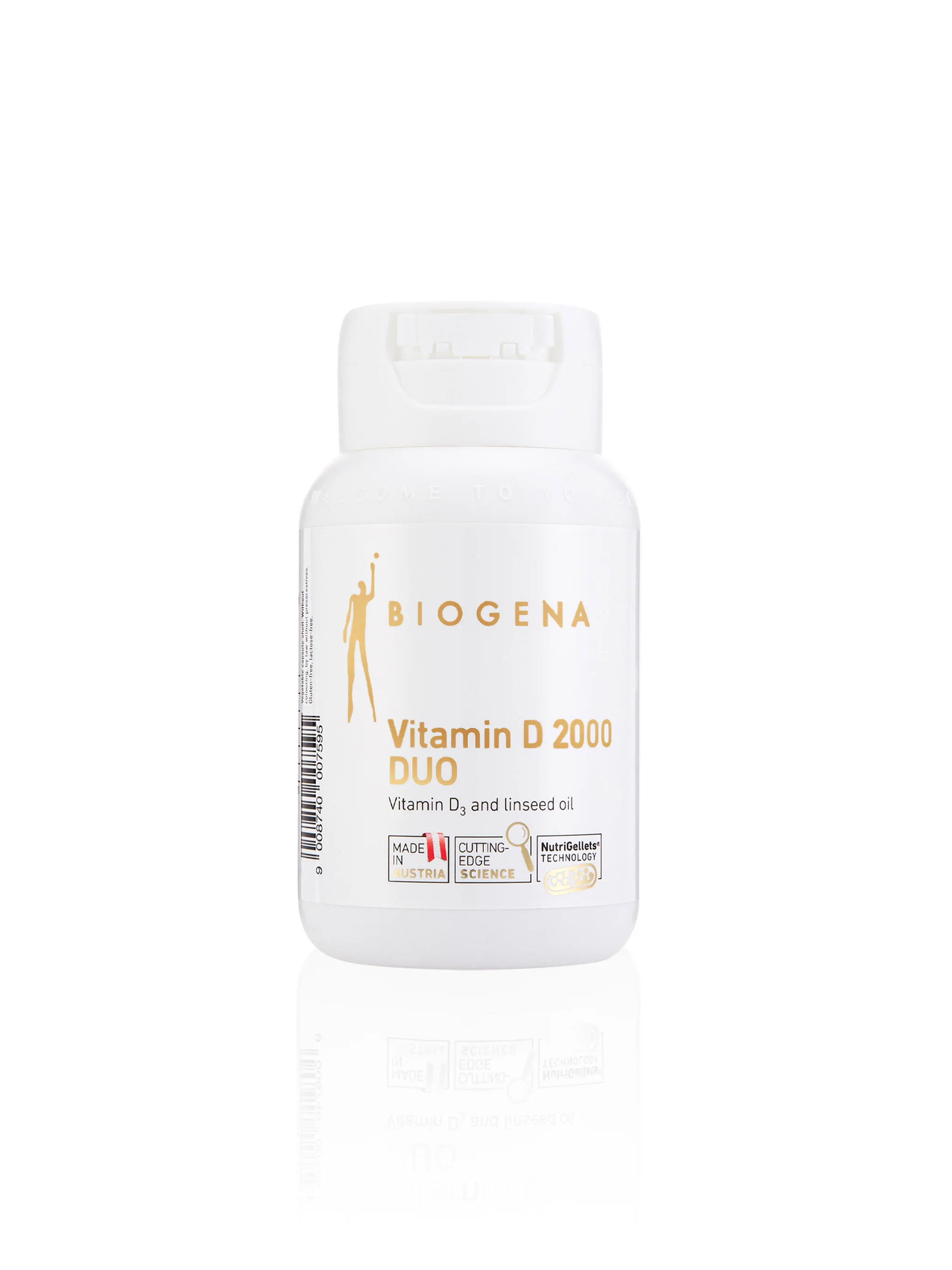

Vitamin D deficiency despite Dubai sunlight – here's how to fix it
_quality(70)-(4).webp)
The causes: How a vitamin D deficiency develops
Vitamin D occupies a special position among vitamins because its primary requirement is not met through diet, as is usually the case, but is produced by our bodies themselves through sunlight. Theoretically, 80–90% of our vitamin D needs can be met by the body through sunlight. However, in practice, several factors hinder sufficient vitamin D production . For example, our modern lifestyle, which takes place predominantly indoors , can impede adequate vitamin D levels. Other factors also influence vitamin D production in the body.
Vulnerable vitamin D synthesis & possible influencing factors:
- Too little sun exposure
- Too low an angle of incidence or intensity of the sun
- Heavy cloud cover
- window panes
- dark complexion
- Covered skin
- Sunscreen with a high sun protection factor (>20)
- Advanced age
- cold
- Increased need
- Kidney disease
- Indigestion
Too little sun exposure
Particularly affected by low vitamin D stores are – as already mentioned – people with low or no sun exposure, for example due to limited mobility or being bedridden; but school-age children or people working in shifts should not be forgotten here either – all these people usually spend most of the day indoors.
For this reason, experts recommend that students or office workers, for example, use their lunch break to go outside for at least 15 minutes on as many sunny days as possible (without sunscreen and with their face, neck, and hands uncovered). However, fresh air is by no means a guarantee of sufficient vitamin D production.
Angle of incidence & intensity of the sun
Furthermore, the body's own production depends on the position of the sun or the angle of incidence of the sun's rays : Only when the UV-B index reaches a value of more than 3 , which corresponds to UV-B radiation of 290 to 315 nm , is the sunlight strong enough.
A simple rule of thumb for assessing whether the intensity of sunlight is sufficient for the body's own vitamin D synthesis is to compare the shadow cast by the body's height : If the shadow is longer than you are tall, the radiation intensity is too low. Accordingly, in our latitudes, the body's own vitamin D synthesis almost completely ceases between October and March; and even in the morning and evening hours, the radiation is insufficient.
Dark skin color
People with dark skin can also be affected, as a high melanin content in the skin slows down the production of vitamin D.
Old
The body's own production of vitamin D decreases by up to 50% with age , which is why people aged 65 and over should pay particular attention to maintaining stable vitamin D levels.
Cold & Sun Protection
Furthermore, cold temperatures or the use of high sun protection factors affect vitamin D production in the body.
It was previously assumed that the body's own vitamin D production was almost completely suppressed by skin creams, makeup, or sunscreens with a sun protection factor (SPF) above 8. More recent data shows that sufficient vitamin D production occurs when using sunscreens with moderate SPFs up to 20. However, with very high SPFs above 20, which are often recommended for children or during summer holidays with high sun exposure, a reduction in vitamin D production is likely.
Pregnancy, breastfeeding & babies
Pregnant and breastfeeding women also have an increased need, as do infants in their first year of life who need to be protected from direct sunlight.
02. Mission Impossible: Meeting needs through nutrition
Besides the body's own production, vitamin D can also be obtained through food – however, the German-Swiss Nutrition Societies (DA-CH) agree that meeting the body's needs solely through a typical diet is virtually impossible . The Austrian Nutrition Report also confirms this: Liver and fatty fish , such as salmon, sardines, eel, and herring, contain significant concentrations of vitamin D, but are not typically consumed daily or in large quantities. More popular sources of vitamin D, such as egg yolks, milk, and dairy products, contain only very limited amounts and are therefore unsuitable for meeting daily requirements. Especially when the body's own production is low or nonexistent, diet alone is insufficient to reach the target reference value of at least 800 IU (International Units).
03. Possible symptoms and consequences of vitamin D deficiency
Numerous scientific findings from the last two decades attribute an important preventive role to vitamin D in maintaining the health of the entire organism. Accordingly, the potential symptoms and consequences of a vitamin D deficiency are also far-reaching.
How does a vitamin D deficiency manifest itself? An overview of possible effects:
- Head & Nerves : Irritability, restlessness, migraines, tinnitus
- Hair : Hair loss
- Immune system : susceptibility to infections, autoimmune reactions, allergies, increased risk of cancer
- Muscles : Muscle weakness, pain, joint pain, muscle cramps
- Bones : Disturbed bone mineralization (children: rickets, adults: osteomalacia), calcium deficiency, bone pain and deformities, bone fractures
The dark season – a “flowering season” for infections
- In winter, flu-like infections and colds are rampant. Doctors and researchers have long suspected that this annual wave of illness is at least exacerbated by low vitamin D levels . Vitamin D activates both antiviral and antibacterial proteins and also influences other immune processes. A vitamin D deficiency, on the other hand, can weaken the immune system . There is considerable evidence for a link between vitamin D and respiratory illnesses – supported by a growing number of studies. For example, an Austrian study revealed a correlation between the frequency of infections and illnesses among employees and their poor or suboptimal vitamin D levels.
04. Target group at risk for vitamin D deficiency
he Robert Koch Institute estimates that vitamin D levels in the blood are deficient in over 57% of adults. The situation is even more precarious among the elderly population. Many older people spend less time outdoors due to health reasons or limited mobility. In addition, skin becomes thinner with age, significantly reducing the body's ability to produce vitamin D.
Other risk groups for vitamin D deficiency:
- People with little or no sun exposure
- Shift workers
- Older people
- Infants and toddlers, as well as growing children
- Pregnant women and breastfeeding mothers
- People who wear long clothing continuously
- dark-skinned people
- Smokers:
Vitamin D deficiency in children
A child's body is constantly growing and changing. Therefore, it is all the more important to provide growing children with sufficient micronutrients. As a regulator of calcium and phosphate metabolism, vitamin D plays a crucial role in bone strength. A deficiency prevents bones from incorporating minerals into their structure. As a result, the bones remain soft and become deformed. This condition is known medically as rickets .
To keep the risk of rickets in check, a potential vitamin D deficiency should be prevented in babies : breast milk contains insufficient amounts of vitamin D, and the levels in formula are also inadequate . At the same time, babies' sensitive skin should not be exposed to direct sunlight. Therefore, babies are advised to take vitamin D (400-500 IU) preventively. According to the German Society for Pediatrics and Adolescent Medicine (DGKJ), this recommendation applies until the child's second spring or early summer.
But what about older children? Their vitamin D levels are far from optimal – and this during a crucial developmental phase for bone formation and growth. A study by the German Robert Koch Institute (KiGGS study) found that 62% of boys and 64% of girls between the ages of 3 and 17 had a reduced vitamin D level (< 50 nmol/L) in their blood .
Vitamin D deficiency symptoms in children
While rickets is now rare thanks to the recommended vitamin D supplementation (from the first week of life until the second spring/early summer), other signs of vitamin D deficiency in children are not particularly specific. The following symptoms may indicate a vitamin D deficiency in children:
- Susceptibility to infection
- Pronounced fatigue
- Performance weakness
- Unrest
- Sleep disorders
- Increased sweating
Vitamin D drops for children to support healthy growth, healthy bone development and normal immune system function.
05. Measuring and diagnosing vitamin D deficiency
Vitamin D is the only vitamin that is primarily obtained not through diet, but through sunlight. And yet, studies repeatedly show that the vitamin D stores of many Europeans are depleted. Many people are probably now wondering about their own vitamin D levels.
How can you detect a vitamin D deficiency?
A vitamin D test can easily clarify this situation. To determine vitamin D status, the test measures the level of 25-hydroxyvitamin D3 in the blood, and the result is reported either as nmol/l or ng/ml, depending on the laboratory . (To convert from nmol/l to ng/ml, simply divide the nmol/l value by 2.5.)
Values – when is a vitamin D deficiency diagnosed?
A vitamin D level of 75 nmol/l or 30 ng/ml or higher indicates a mild deficiency. A level below 50 nmol/l or 20 ng/ml indicates a severe vitamin D deficiency. Here is an overview of all the relevant values:
Status assessment
25-Hydroxy-D serum level (nmol/L)
25-Hydroxy-D serum level (ng/ml) (-> equivalent to “µgl/L”)
Severe shortage | < 50 nmol/L | < 20 ng/ml
Slight deficiency | 50 - 75 nmol/L | 20 - 30 ng/ml
Adequate supply | 75 - 100 nmol/L | 30 - 40 ng/ml
Optimal care | 100 - 150 nmol/L | 40 - 60 ng/ml
Table : Assessment of Vitamin D Status
06. Correct vitamin D deficiency – or better yet, prevent it in the first place.
A long-term vitamin D deficiency can have various and sometimes serious consequences. Therefore, it is all the more important to take targeted action against vitamin D deficiency or, ideally, to avoid it altogether.
What can be done about it?
To quickly correct a vitamin D deficiency, it is recommended to supplement with a vitamin D supplement under medical supervision . The chosen dosage should be based on individual body weight. Online vitamin D calculators can help in selecting the correct dosage and the desired duration of supplementation. Due to the health benefits, optimal vitamin D levels should be the goal, not just sufficient levels.
How long does it take to correct a vitamin D deficiency?
How long it takes to correct a vitamin D deficiency depends on various factors. These include the severity of the deficiency, the dosage, and the individual's body weight . Generally, however, it takes a few weeks to a few months.
07. Conclusion
Vitamin D occupies a special position among vitamins because its primary requirement is not met through diet, as is usually the case, but is produced by our bodies themselves with the help of sunlight. Nevertheless, for many people, diet and sun exposure alone are insufficient to achieve optimal vitamin D levels. In this case, it is advisable to supplement intake with a high-quality vitamin D supplement.